

Understanding Technical and Fundamental Analysis: Key Strategies for Investors
Investors often approach the stock market from different perspectives. One may view a stock as a promising business opportunity, while another might see a concerning price trend. Both viewpoints hold validity, as technical analysis and fundamental analysis are essential methods for evaluating stocks. Each approach seeks to answer the critical question: should you buy, hold, or sell? The distinction lies in their methodologies and areas of focus.
Fundamental Analysis: Understanding the Business
Fundamental analysis begins with evaluating a company’s financial health and economic position. This method involves examining revenue, earnings, debt, margins, and cash flow, as well as assessing management quality, industry trends, and competitive advantages.
The primary goal is to estimate the intrinsic value of the business and compare it to the current stock price. If the stock trades below its estimated value, it presents an opportunity; if it trades above, it indicates potential risk.
Key Questions in Fundamental Analysis
When conducting fundamental analysis, investors should consider:
- Is the company growing revenue?
- Are profits stable or expanding?
- Does it carry excessive debt?
- Is management effectively allocating capital?
- Does the company possess a sustainable competitive advantage?
Additionally, macroeconomic factors such as interest rates, inflation, and economic cycles can significantly influence company performance.
Valuation: Your Anchor
Valuation is a crucial aspect of fundamental analysis. Common tools include:
- Price to earnings ratio
- Price to sales ratio
- Discounted cash flow models
- Return on equity
- Free cash flow yield
These metrics assist in estimating intrinsic value, which serves as an anchor during market fluctuations.
Technical Analysis: Reading Price Behavior
In contrast, technical analysis focuses on price and volume, utilizing charts as primary tools. This approach posits that all known information is reflected in the price, emphasizing the study of price behavior rather than financial statements.
Technical analysts seek to identify patterns that arise from human psychology, as fear and greed create recurring trends over time. Key elements of technical analysis include:
- Trends
- Support and resistance levels
- Momentum shifts
- Volume spikes
- Chart patterns like head and shoulders or double bottoms
Indicators such as moving averages, relative strength index, and MACD are also vital for determining entry and exit points.
The Core Difference
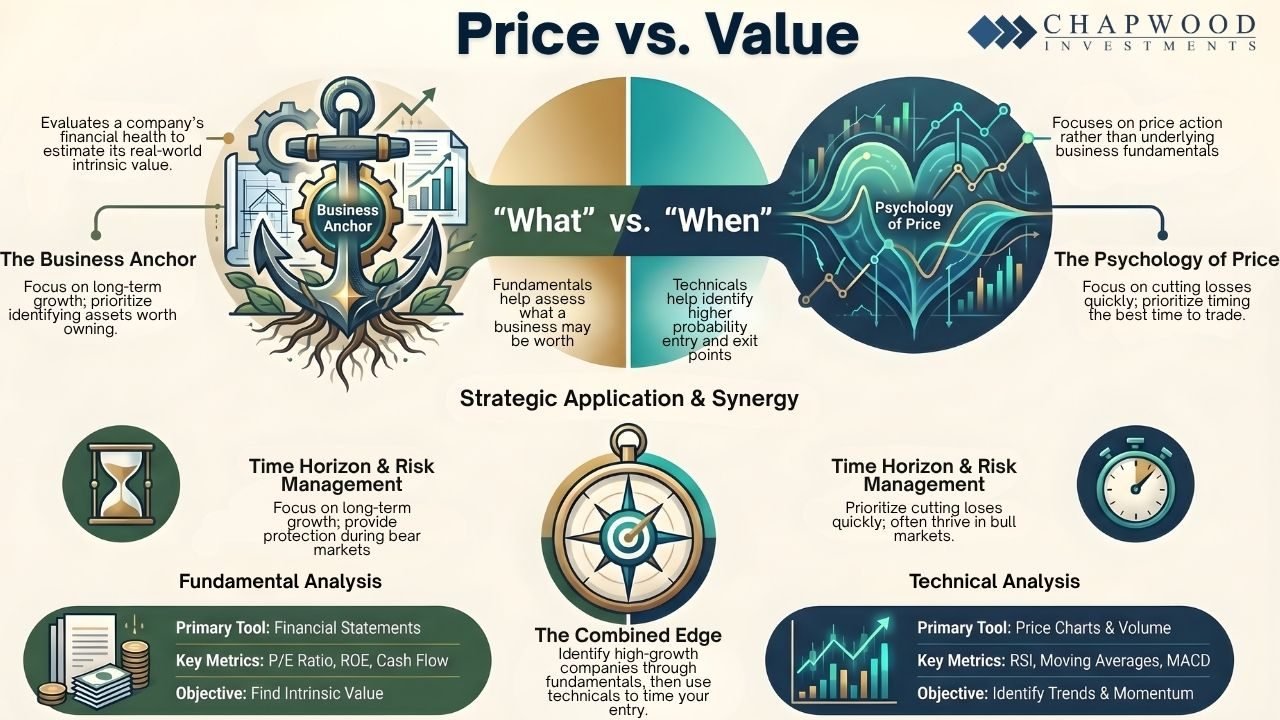
Fundamental analysis primarily answers the question of what to buy, while technical analysis focuses on when to buy.
Time Horizon and Risk
The two approaches differ significantly in terms of time frame and risk management:
- Fundamental investors: Think in years, focus on long-term growth, accept short-term volatility, and rely on valuation margins for protection.
- Technical traders: Operate on shorter time frames, trade weeks or days, focus on price action, and quickly cut losses when trades do not perform as expected.
When They Disagree
Conflicts can arise between fundamental and technical perspectives. For instance, a company may exhibit strong earnings and low debt, prompting a fundamental investor to buy, while a technical analyst might identify a downtrend and choose to wait. Conversely, a stock might show strong momentum, attracting technical traders, while fundamental investors may be deterred by weak earnings.
Strengths and Weaknesses
Each approach has its strengths and weaknesses:
- Fundamental analysis: Effective in stable markets for identifying high-quality businesses but may struggle with timing.
- Technical analysis: Excels in timing and capturing trends but lacks the context of business fundamentals.
Different Data, Different Skills
Fundamental analysis relies on financial statements, economic reports, and company filings, while technical analysis depends on price charts and volume data. This distinction leads to different skill sets required for each approach.
Market Behavior and Efficiency
Market efficiency impacts both analysis methods. In highly efficient markets, fundamental analysis may face challenges, while technical analysis can exploit short-term inefficiencies. Behavioral finance supports technical analysis by highlighting how fear and greed influence market cycles.
Why Many Investors Use Both
Many investors find value in combining both approaches. They might use fundamentals to identify strong companies and technical analysis to time their entries and exits. For example, one might identify a company with robust earnings growth, wait for a pullback, and then enter when momentum turns positive.
Mindset Matters
Fundamental analysis seeks certainty, expecting value to align with price, while technical analysis embraces uncertainty, focusing on probabilities and price reactions. Both require discipline, with fundamental investors needing patience and technical traders requiring decisiveness.
Market Conditions Change What Works
In bull markets, technical analysis often thrives, while in bear markets, fundamentals take precedence. Factors such as interest rates, liquidity, and volatility can shift the effectiveness of each approach.
When to Use Each
Utilize fundamental analysis when:
- You are investing for the long term
- You want to own quality businesses
- You focus on value and growth
- You can accept short-term volatility
Employ technical analysis when:
- You prioritize timing
- You trade shorter time frames
- You follow trends
- You manage risk through price signals
The biggest mistake investors can make is to remain blindly loyal to one method. Markets are dynamic, and flexibility is essential. Ultimately, both technical and fundamental analyses provide valuable insights into market behavior, with value driving long-term outcomes and price influencing short-term movements. Mastering both approaches can enhance decision-making and improve consistency in investment strategies.
Learn more at: https://chapwoodinvestments.com/ | Email: ed@chapwoodinvestments.com | Call: (972) 865-2225
Chapwood Investments, LLC, is a partner of Ethos Financial Group, LLC, a Securities and Exchange Commission-registered investment advisor. No mention, opinion, or omission of a particular security, index, derivative, or other instrument in this article constitutes an opinion on the suitability of any security. The information and data presented here were obtained from sources deemed reliable, but their accuracy and completeness are not guaranteed. At any given time, principals at Chapwood Investments, LLC may or may not have a financial interest in any or all of the securities or instruments discussed in this article. Guest contributors do not receive compensation and do not provide endorsements or testimonials. Past performance is not indicative of future results.